DETAILED DECISION WORKFLOW
Put the principle into a project decision.
Compare the solids-handling problem first
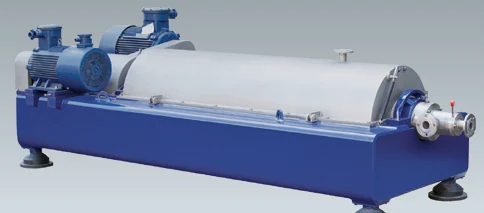
A decanter uses a scroll to transport separated solids along a rotating bowl. A disc-stack separator uses closely spaced discs to create a large effective settling area, with a solids-discharge arrangement selected for its duty. This difference affects how each machine handles the incoming solids burden and the required product stream. Avoid a rule that assigns every fine particle to one technology or every concentrated feed to another. Actual geometry, feed properties and discharge configuration matter. Use the qualitative comparison to decide which trials to request, then judge the tested machine rather than an unrestricted technology slogan.
Define liquid quality with a measurement
“Clear liquid” can mean visually transparent, low suspended solids, low turbidity or low concentration of a particular contaminant. These are not interchangeable measures. Some dissolved components can affect colour or conductivity while remaining in the liquid after mechanical separation. If an optical measurement is used, agree how it relates to the process acceptance target. Collect liquid samples under a consistent method because settling in the sample bottle can improve the apparent result without improving the machine. Record the feed properties and solids recovery at the same time as liquid quality.
Two-liquid separation needs a separate review
Both technology families can include configurations intended for two liquid phases and solids, but a general two-phase machine should not be assumed to perform that duty. Establish the liquid densities and viscosities at operating temperature, the phase-ratio range, emulsion stability and required purity of both liquid outlets. A product brochure naming three-phase separation does not show how your emulsion behaves. Test all relevant outlets and close the material balance. If a stable emulsion dominates the result, review the upstream process and possible conditioning with qualified specialists instead of assuming that more acceleration will solve the problem.
Think in process stages
A process may first need to remove a substantial solids burden and then polish the liquid to a more demanding quality. In that case, the first stage and second stage have different design duties. Ask what feed will actually reach the polishing separator after the primary machine, including the residual fine fraction and any changes caused by conditioning. The combined route introduces additional interfaces, energy and maintenance, so it must justify its value against a single-stage alternative. Do not credit the second machine with performance measured on a cleaner laboratory feed than the plant will deliver.
Normalize resource and operating comparisons
Compare measured package energy, cleaning requirements, chemical use and maintenance scope on the same amount of acceptable product. Include any feed pump, discharge system or polishing filter required by one option. A smaller footprint does not automatically mean a smaller installation envelope once service access and auxiliaries are included. A lower main-drive motor rating also does not establish lower energy per tonne. Ask suppliers to state the operating schedule and the evidence supporting consumable or service intervals. Estimates are useful when clearly labelled and examined through sensitivity analysis.
What to send with an enquiry
Send the feed mass and volume rates, solids concentration basis, particle-size information, liquid properties and a specification for each outlet. Identify the valuable product and any restrictions on shear, temperature or cleaning. Ask whether the supplier recommends a decanter, a disc-stack trial, or a staged process, and request the reason. This website lists HUADA decanter equipment and discusses disc-stack separation as a technical alternative; it does not represent disc-stack equipment as a supplied HUADA product without a separately confirmed scope.