Skip to content
HUADA · Industrial centrifuges & complete separation systems
CENTRIFUGE TECHNOLOGY

Engineering and safety

Interlocks, safe access and the scope of a control system

A control-system specification should explain what the machine does when a condition is unsafe or unavailable. A list of sensors is not enough. Safe access, speed monitoring, vibration, overload and relevant temperature or position signals need an agreed functional response suited to the machine and process.

What matters in the process

Operating control and protective functions can have different design requirements. Define responsibilities for the machine package and for site-wide controls. The ability to run a recipe or communicate with a DCS does not automatically establish the adequacy of a safety function. Isolation for maintenance and access must follow the approved equipment and site procedures.

A practical example

A discharge fault might require the feed to stop while other parts of the sequence move to a defined state. Without a cause-and-effect document, the supplier and plant may assume different responses. Review faults at pumps, conveyors and utilities as well as faults inside the centrifuge.

What to check or specify

  • Request a cause-and-effect matrix and I/O list.
  • Define machine and plant-control boundaries.
  • Include safe access and maintenance isolation requirements.
  • Witness agreed protective-function tests at FAT and site.

Turn the result into a decision

Never bypass an interlock to achieve a trial result or recover production. Resolve the cause under the approved procedure and verify the protection before returning to service. The website explains specification questions; operating instructions must come from the supplied machine documentation.

Equipment context: supplied HUADA English catalogue, PDF pages 12, 24, 30, 56. Numerical examples are illustrative calculations. Application guidance must be confirmed for the actual material and selected equipment.

Further reference: OSHA — control of hazardous energy.
Related equipment

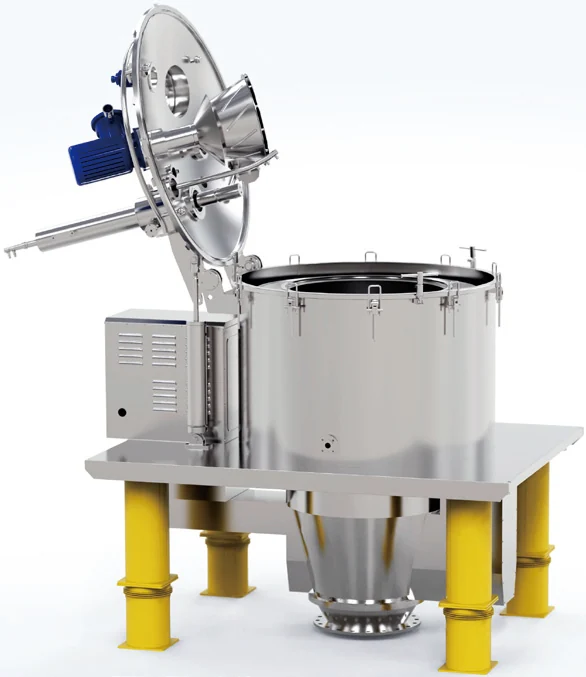
HUADA LW / LWX / LWS / LWFX / LWZ — Decanter Centrifuges

LW / LWX / LWS / LWFX / LWZ

Decanter Centrifuges

Continuous solid-bowl separation for clarification, thickening and dewatering, with two-phase, three-phase and specialized configurations.

View details

Continue reading

SOURCE & SCOPE

Read the evidence in context.

General engineering guidance and original illustrative examples. HUADA model information should be checked against the current catalogue and project quotation. External technical references explain principles; their product specifications do not describe HUADA equipment.

Editorial method & corrections

CONTINUE YOUR RESEARCH

CIP in a centrifuge: access, coverage and verification CIP and SIP are different requirements Hazardous-area information required in a centrifuge RFQ Cleaning & process safety

TURN THE QUESTION INTO A SPECIFICATION

Bring your feed. Define your result.

Capture the assumptions, then discuss the right trial and equipment scope.

Build a process brief

Your next separation project

Start with your material. Build the right system.

Share your process conditions, product targets and installation requirements.

Request a quote ↗WhatsApp ↗
滚动至顶部