Skip to content
HUADA · Industrial centrifuges & complete separation systems
CENTRIFUGE TECHNOLOGY

Process performance

How viscosity and temperature change separation

Liquid viscosity influences how readily liquid drains through a cake and how particles move during sedimentation. Temperature can change viscosity, solubility, density and material stability at the same time. A room-temperature sample may therefore give a poor prediction for a hot process or a low-temperature extraction duty.

What matters in the process

When viscosity increases, drainage or settling can become slower under otherwise comparable conditions. However, heating is not a universal solution: crystals may dissolve, the product may degrade, seals may be affected or solvent hazards may change. Cooling can also create crystallization inside transfer lines or alter cake structure. The tested condition should represent the expected machine inlet, not merely the storage tank.

A practical example

An illustrative crystallization slurry may reach the centrifuge warmer than the laboratory sample. If the product dissolves more readily in warm wash liquid, the apparent recovery and wash demand may differ. Measure temperature at the feed and wash points and account for any phase change during the test.

What to check or specify

  • Provide viscosity at relevant temperatures.
  • State normal and extreme inlet temperatures.
  • Describe solubility, crystallization and degradation risks.
  • Confirm material, seal and bearing temperature ratings.

Turn the result into a decision

Include temperature control, insulation or heat-exchange interfaces in the scope where they matter. Ask for performance data at the agreed process condition. Do not extrapolate a catalogue capacity across a large viscosity change without a validated basis.

Equipment context: supplied HUADA English catalogue, PDF pages 9–12, 23–25, 43–50. Numerical examples are illustrative calculations. Application guidance must be confirmed for the actual material and selected equipment.
Related equipment

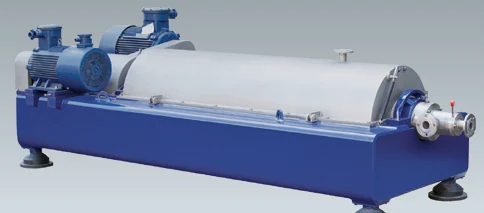
HUADA LW / LWX / LWS / LWFX / LWZ — Decanter Centrifuges

LW / LWX / LWS / LWFX / LWZ

Decanter Centrifuges

Continuous solid-bowl separation for clarification, thickening and dewatering, with two-phase, three-phase and specialized configurations.

View details

Continue reading

SOURCE & SCOPE

Read the evidence in context.

General engineering guidance and original illustrative examples. HUADA model information should be checked against the current catalogue and project quotation. External technical references explain principles; their product specifications do not describe HUADA equipment.

Editorial method & corrections

CONTINUE YOUR RESEARCH

Designing a cake-washing trial Selecting filter cloth for a centrifuge Residual cake heel: why it matters Filtration & cake washing

TURN THE QUESTION INTO A SPECIFICATION

Bring your feed. Define your result.

Capture the assumptions, then discuss the right trial and equipment scope.

Build a process brief

Your next separation project

Start with your material. Build the right system.

Share your process conditions, product targets and installation requirements.

Request a quote ↗WhatsApp ↗
滚动至顶部