Skip to content
HUADA · Industrial centrifuges & complete separation systems
CENTRIFUGE TECHNOLOGY

Fundamentals

Filtration versus sedimentation centrifuges

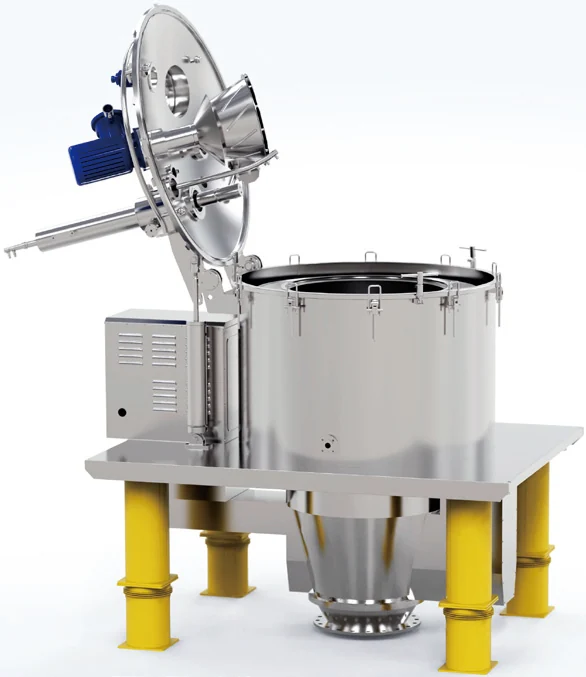
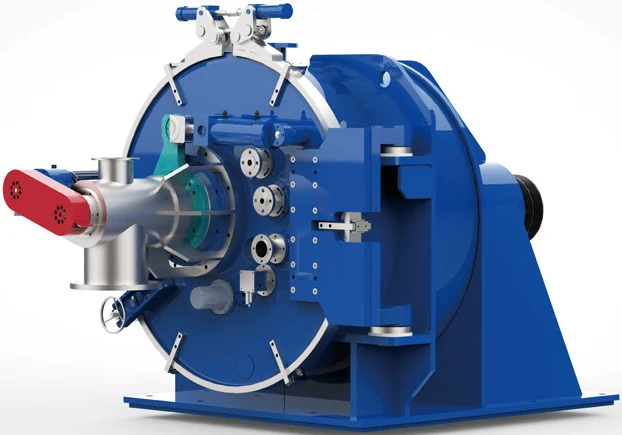
Filtration and sedimentation separate by different mechanisms. A filtration centrifuge retains a solid bed on a permeable medium while liquid flows through it. A sedimentation centrifuge separates phases by their relative densities in a rotating bowl. Choosing between them starts with the behaviour of the suspension and the product that must be recovered.

What matters in the process

A filter cloth or screen can retain particles that build a suitable cake, but the cake itself often controls liquid flow. Fine or compressible solids may resist drainage even when the cloth opening is appropriate. A decanter does not need a cloth: particles must migrate toward the bowl wall fast enough for separation, then be conveyed without exceeding mechanical limits. Dissolved material does not become a separable solid merely because the feed is centrifuged.

A practical example

A crystallization slurry may need cake washing to displace mother liquor, making basket filtration worth evaluating. A wastewater sludge may need continuous capture of fine solids, directing attention to sedimentation and conditioning. A suspension can also justify a combined design, but the additional stage must solve a measured problem rather than add complexity without evidence.

What to check or specify

  • Test whether the solids form a drainable cake.
  • Measure particle distribution and phase densities.
  • Specify filtrate or centrate quality separately from cake quality.
  • Assess whether the process needs cake washing or only clarification.

Turn the result into a decision

Compare technologies with a common material balance. Include solids lost to the liquid, dissolved impurities remaining in the cake and downstream treatment requirements. If one machine cannot meet all objectives economically, a staged process may be more appropriate than a larger single centrifuge.

Equipment context: supplied HUADA English catalogue, PDF pages 9–12, 23–47. Numerical examples are illustrative calculations. Application guidance must be confirmed for the actual material and selected equipment.
Related equipment

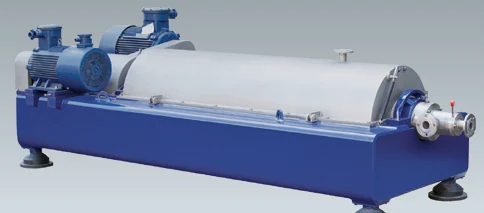
HUADA LW / LWX / LWS / LWFX / LWZ — Decanter Centrifuges

LW / LWX / LWS / LWFX / LWZ

Decanter Centrifuges

Continuous solid-bowl separation for clarification, thickening and dewatering, with two-phase, three-phase and specialized configurations.

View details

Continue reading

SOURCE & SCOPE

Read the evidence in context.

General engineering guidance and original illustrative examples. HUADA model information should be checked against the current catalogue and project quotation. External technical references explain principles; their product specifications do not describe HUADA equipment.

Editorial method & corrections

CONTINUE YOUR RESEARCH

How to select an industrial centrifuge Particle-size distribution: the missing selection input Suspended solids versus dissolved solids: what a centrifuge can separate Separation fundamentals

TURN THE QUESTION INTO A SPECIFICATION

Bring your feed. Define your result.

Capture the assumptions, then discuss the right trial and equipment scope.

Build a process brief

Your next separation project

Start with your material. Build the right system.

Share your process conditions, product targets and installation requirements.

Request a quote ↗WhatsApp ↗
滚动至顶部