DETAILED DECISION WORKFLOW
Put the principle into a project decision.
Step 1: write an outlet specification
Begin with a simple flow sketch showing every inlet and outlet. Name the valuable component and state whether it is recovered in a solid or liquid stream. For each outlet, define the measurement that determines acceptance: suspended solids, target-component assay, moisture, impurity concentration or another process-specific result. A specification such as “high separation efficiency” leaves the supplier to guess which result matters. A specification such as “recover the target crystals while reducing retained mother liquor, without exceeding the agreed fines increase” creates a testable engineering question. Establish the actual numerical limits with your process team; this guide does not supply universal values.
Step 2: describe variability, not just a nominal feed
Provide minimum, normal and maximum feed conditions, and explain whether the extremes occur together. A peak hydraulic flow and a peak solids concentration may belong to different operating cases. Include temperature, viscosity, density, particle-size distribution, dissolved material and any added chemicals. For a batch process, record how properties change through the campaign. For a continuous process, identify short flushes, upstream interruptions and changes in product grade. These details determine what a supplier must demonstrate and whether the plant needs equalization or a controlled feed limit.
Step 3: separate the technology decision from the model decision
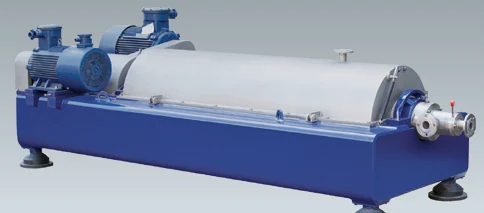
First decide which mechanisms are physically plausible. Does the material settle under centrifugal acceleration? Does it form a permeable cake? Can particles be retained on a practical screen? Does washing require a controlled batch? Only then compare machine sizes and variants. A larger basket cannot fix a fundamentally unsuitable filtration mechanism, and a higher nominal speed cannot remove a dissolved component that remains in one liquid phase. Keep an alternative route in the discussion until testing has resolved the main uncertainty. In some processes, a decanter followed by a polishing step is a better-defined duty than asking one machine to achieve both high solids handling and fine clarification.
Step 4: compare the complete operating sequence
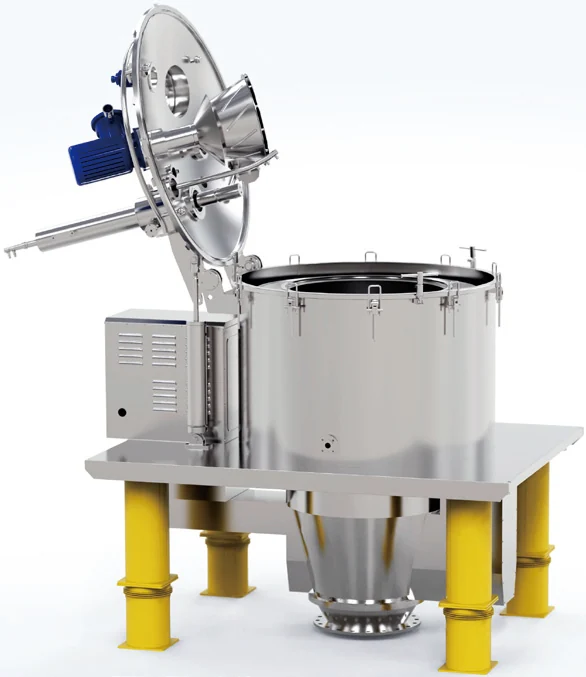
For batch filtration, count filling, filtration, washing, spinning, discharge and any recurring heel treatment. Include campaign cleaning and changeover in the production schedule without counting the same downtime twice. For a continuous decanter, consider start-up, stable operation, feed interruptions, cleaning and shutdown. Review how upstream and downstream equipment responds during each state. Average hourly output is not enough to size a hopper receiving a short batch discharge. A continuous feed source also needs a defined response when a batch centrifuge temporarily stops accepting feed.
Step 5: use a common decision sheet
Give shortlisted suppliers the same feed envelope and ask them to identify their assumptions and exclusions. Compare product quality, recovery, throughput and resource consumption at the same operating point. Record which figures were measured, which were calculated and which remain estimates. A quote that includes a complete feed and discharge package should not be compared directly with a bare-machine price. Resolve material uncertainties before turning indicative capacity into an acceptance commitment. Where the source data are incomplete, buy a targeted trial or engineering review first rather than treating an unverified model number as a finished specification.
A practical decision record
Keep a short record with five conclusions: the chosen separation principle and reason; the alternative that was evaluated and why it was not selected; the tested feed envelope; unresolved risks and their planned resolution; and the agreed supply and acceptance boundary. Link that record to the actual trial report and offered configuration. This makes later design changes easier to assess. If the feed changes after purchase, the record also shows which original assumptions need to be revisited. The final selection remains a process-specific engineering decision, not the output of a website calculator.